
TD;LR
f pages on your site are not appearing in your Prerender.io cache, the cause is almost always one of three things: the page has not been cached yet (or has been evicted), the page does not return a 200 OK status, or the URL matches an entry in your Ignored URLs list. Work through the three checks below in order, fix whichever cause applies, and re-test.
Why caching matters
Prerender.io renders your JavaScript pages and caches the HTML so AI crawlers and search engines receive an instant response on subsequent visits. If a page is not being cached, Prerender.io still renders it on each crawler request, which increases your render usage and slows down what crawlers receive.
Pages that are rendered but not cached can also cause inconsistencies between what AI crawlers see and what your website visitors see, which may affect citations and search rankings.
ℹ️ If you would rather have an interactive walk-through, ask Nexus, your AI integration assistant, inside your Prerender.io dashboard. Paste the affected URL and Nexus will help you narrow down the cause.
Step 1: check whether the URL is in your cache manager.
Start here. If the URL is in the cache manager, the issue is not caching itself but something else, for example a stale cached version. If it is not in the cache manager, continue to Step 2.
- Open your Prerender.io dashboard and go to Cache Manager.
- Paste the affected URL into the search bar above the table.
- Look for the URL in the results:
- If the URL appears, it is cached. The issue may be elsewhere (cache freshness, headers, or rendering).
- If the URL does not appear, it has not been cached. Continue to Step 2.
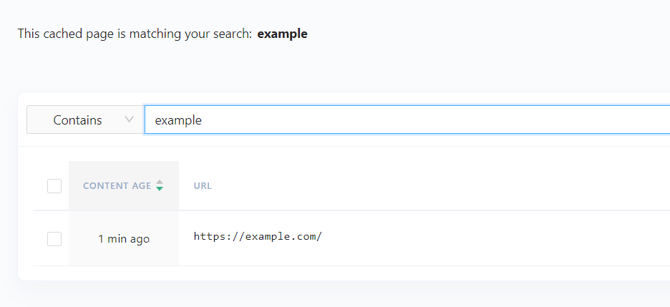
A URL that previously appeared in the cache but no longer does has either been evicted because of plan limits, expired due to your cache expiration settings, or been intentionally excluded. Step 3 covers the exclusion case.
Step 2: verify the page returns a 200 OK status.
Prerender.io only caches pages with a 200 HTTP status code. Pages returning 301, 404, 500, or any other non-200 code are rendered and served to crawlers, but they are not stored in the cache.
- Open the affected URL in your browser.
- Press
F12, or right-click the page and select Inspect, to open Developer Tools. - Click the Network tab.
- Press Enter to reload the page.
- Click the first item in the Network tab list (the document request). The status code appears at the top of the response details.
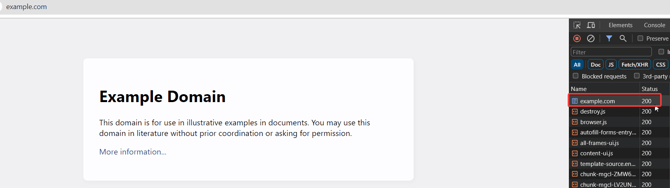
If the status code is anything other than 200, Prerender.io will render the page but will not cache it. Fix the underlying status code at your application or server level, then re-trigger a render to populate the cache.
⚠️ A <meta name="prerender-status-code" content="..."> tag in the page <head> overrides the HTTP status code for Prerender.io. Check the head of the page for this tag. If it is set to a non-200 value, Prerender.io will treat the page accordingly and will not cache it, even if the HTTP response itself is 200 OK.
Step 3: check whether the URL is in your Ignored URLs list.
If the URL returns 200 OK and is not in the cache manager, it may be matching an entry in your Ignored URLs list. The list supports regular expressions, so a URL can be excluded by a pattern match, not just by exact match.
- Open your Prerender.io dashboard and go to Cache Manager.
- Click the Ignored URLs tab at the top of the page.
- Look through the list for either the exact URL or a pattern that could match it.
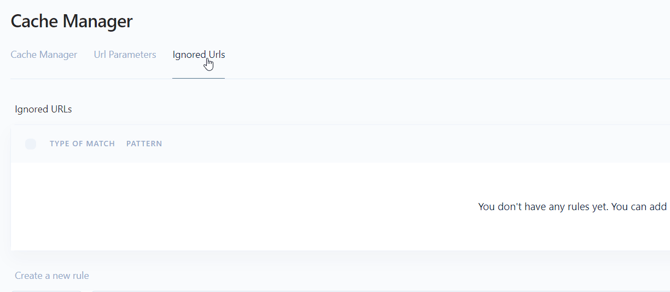
If the URL, or a pattern that matches it, appears in the list, Prerender.io is intentionally skipping cache for that page. Remove or refine the rule if you want the page cached, then trigger a fresh render.
⚠️ Broad regular expressions can match more URLs than you intend. If you are not sure whether a pattern is matching your URL, test it against your URL using a regex tester before changing it.
Still not cached?
If the URL returns 200 OK, is not in the Ignored URLs list, and is still not appearing in the cache, the next thing to check is whether your Prerender.io integration is working at all on other pages.
→ Run through Verify your Prerender.io integration. If you do not see the Prerender.io headers or IDs on other pages, the integration itself may be the cause, and no pages will cache until it is fixed.
✅ The integration is working when cached pages appear in your Prerender.io dashboard within 2 to 5 minutes of a crawler request.
Best practices to avoid future cache misses
A few habits keep more of your pages in cache and out of trouble.
- Only 200 OK pages get cached. Redirects, errors, and pages with a non-200
prerender-status-codemeta tag are never cached. - Keep Ignored URLs patterns as narrow as possible. Broad regex patterns often match more URLs than intended.
- Use the
/recacheendpoint to force a fresh render for new or recently updated pages. - Tune your cache expiration to match how often your content changes. Aggressive expiration causes more renders; long expiration risks stale content.
Related articles
- How can I tell which URLs failed to cache?
- What does cache miss mean in Prerender.io?
- Ignore rules
- Status codes
💬 Still need help? If a page is still not cached after working through the three checks above, our support team can help diagnose your specific case.
When you contact us, please include:
- The full URL or URLs affected.
- The HTTP status code observed in your browser DevTools.
- Any relevant integration or middleware configuration.
- Screenshots of the cache manager and Ignored URLs tab.
→ Contact us at support@prerender.io