
TL;DR
There are two ways to check the cached HTML Prerender.io serves to AI crawlers and search engines: your Prerender.io dashboard's Cache Manager, or your browser's developer tools with a spoofed crawler user agent. The dashboard method is the fastest option for a quick lookup. The developer tools method shows you the live cached response exactly as a crawler receives it, and requires your Prerender.io integration to be active.
Why check the cached version?
When an AI crawler or search engine visits a URL on your site, it receives the cached HTML that Prerender.io stored during the last render. Checking this cached version lets you confirm that Prerender.io is intercepting crawler requests correctly, and that the content being indexed matches what you expect.
Common reasons to check:
- A page isn't appearing in AI-generated answers or search results as expected.
- You're debugging missing metadata, headings, or structured data in the cached output.
- You've recently updated content and want to confirm the cache reflects the latest version.
ℹ️ If your Prerender.io integration isn't set up yet, Method 2 below won't work. Set up your integration first, then return here to verify. Not sure which integration fits your stack? Ask Nexus, your AI integration assistant, inside your Prerender.io dashboard —describe your setup and Nexus will guide you through configuration.
Check via your Prerender.io dashboard
The Cache Manager in your Prerender.io dashboard lets you view the cached HTML for any URL without changing your browser settings.
Step 1: open Cache Manager in your dashboard.
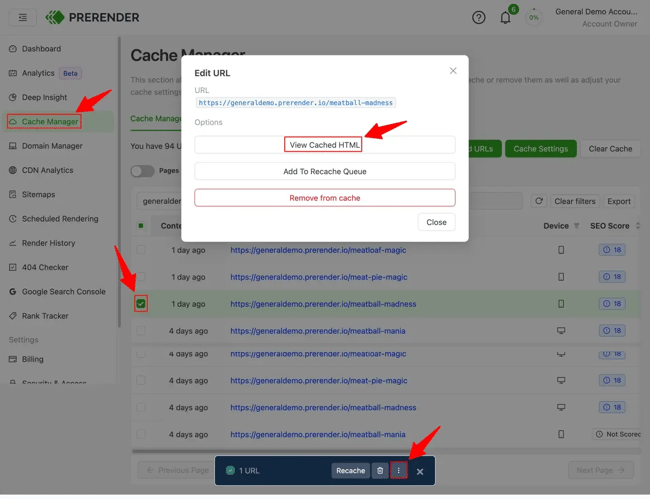
Log in to your Prerender.io dashboard and select Cache Manager from the left navigation menu. If you have multiple domains configured, select the relevant domain from the dropdown at the top of the page.
Step 2: find the URL you want to check.
Locate the URL in the list or use the search bar to find it by path. Select the checkbox to the left of the URL.
Step 3: view the cached HTML.
Click the three-dot menu at the bottom center of the screen, then select View Cached HTML. The cached page opens in a new view, showing exactly what Prerender.io serves to crawlers.
Check via browser developer tools
This method lets you request the live cached response directly from your browser by spoofing a crawler user agent. It gives you the most accurate view of what Prerender.io has stored in its cache at the time of the request.
⚠️ This method only works if your Prerender.io integration is active and routing crawler requests correctly. If you haven't set up your integration yet, see Getting started before continuing.
Step 1: navigate to the URL you want to test.
Open your browser and go to the specific page on your site that you want to inspect.
Step 2: open Developer Tools.
- Windows: Press
Ctrl + Shift + J - Mac: Press
Option + ⌘ + J
Step 3: open the Network Conditions panel.
- Windows: Press
Ctrl + Shift + P - Mac: Press
Command + Shift + P
Type Show Network Conditions in the command palette and select it from the results.

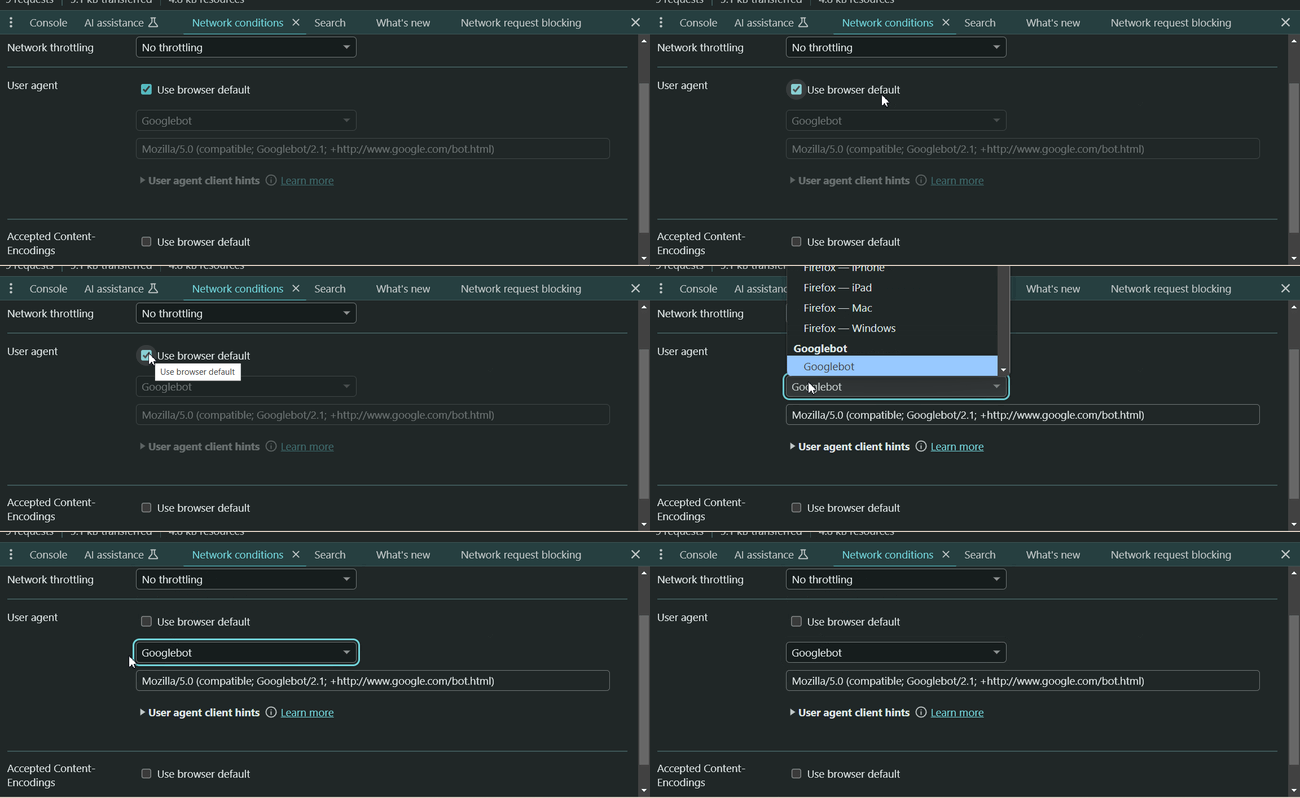
Step 4: set your user agent to Googlebot.
In the Network Conditions tab, uncheck Use browser default. Select Googlebot from the user agent dropdown.
If you've customized your Prerender.io allowlist, select a crawler that is permitted in your settings instead of Googlebot.
Step 5: reload the page and inspect the response.
Press F5 or Ctrl + R (Windows) / fn + f12 (Mac) to reload the page. Your browser now requests the page as a crawler, and Prerender.io serves the cached HTML in response.
Verify your result
After completing either method, confirm the following to be sure Prerender.io served the cached content:
✅ The x-prerender-request-id header appears in your response headers. This confirms that Prerender.io handled the request, not the origin server.
To check response headers in Developer Tools: open the Network tab, reload the page with the Googlebot user agent active, click the main document request, and look for x-prerender-request-id in the Headers tab.
If the header is missing, your integration may not be routing crawler requests through Prerender.io correctly. See Troubleshooting your Prerender.io integration and best practices for step-by-step troubleshooting guidance.
Related articles
- How do I clear my Prerender.io cache?
- How to verify your Prerender.io integration is working
- Getting started
- How Prerender caching works
- Troubleshooting your Prerender.io integration and best practices
💬 Still need help? If the cached HTML isn't what you expected, or the x-prerender-request-id header isn't appearing, our support team can help you diagnose the issue. → Contact us at support@prerender.io