
TL;DR
To fully uninstall Prerender.io: remove the integration code or middleware from your stack, clear all cached pages in your Prerender.io dashboard, verify the x-prerender-requestid response header is no longer present on bot-emulated requests, and confirm the integration shows as not detected in the Domain Manager. Before you start, make sure your origin can serve fully rendered HTML directly, otherwise AI crawlers and search engines will lose visibility into your content as soon as the integration is removed.
⚠️ Before you uninstall. Once Prerender.io is removed, AI crawlers and search engines (Googlebot, Bingbot, GPTBot, ClaudeBot, Perplexity, and others) start receiving your origin's response directly. If your origin returns a JavaScript shell rather than fully rendered HTML for crawlers, your AI search visibility and SEO rankings can drop immediately. Confirm your origin returns crawl-ready HTML before pulling the integration, or plan the uninstall during a low-traffic period so you can verify the impact.
Overview
If you no longer want to use Prerender.io, uninstalling requires a few coordinated steps so that AI crawlers and search engines stop being routed through Prerender.io and pages stop being served from our cache. You should also verify that no residual configuration is still active on your side.
Common reasons readers land on this article:
- You removed the Prerender.io integration code but forgot to clear cached pages.
- Requests are still being intercepted because middleware or proxy rules weren't fully removed.
- Your monitoring tools or analytics show signs that Prerender.io is still handling traffic.
The four steps below cover the full uninstall flow.
How to uninstall Prerender.io
Step 1: remove all integration code and routing rules.
Take Prerender.io out of your stack at the integration layer. Depending on how you originally set up the integration, this could mean:
- Uninstalling or deactivating a Prerender.io plugin (WordPress, Magento 2, Netlify extension, etc.).
- Removing middleware code from your application (prerender-node, prerender_rails, the Apache
.htaccessblock, etc.). - Removing CDN-level routing rules (Cloudflare Worker, CloudFront Lambda@Edge function, Fastly VCL, etc.).
If you are unsure where the integration lives, check your application's routing layer and your CDN configuration against the available integrations list to identify which integration you originally installed.
Step 2: clear all cached pages in your Prerender.io dashboard.
Even after the integration is removed, your cached pages remain in Prerender.io's cache and would still be served if anything routes traffic through us. Clear them to make sure no stale snapshots get served by accident. Follow how to purge your cache for the dashboard steps.
Step 3: verify Prerender.io is no longer serving requests.
Simulate a bot request to one of your pages and inspect the response headers. If the x-prerender-requestid header is missing from the response, Prerender.io is no longer intercepting that traffic.
For the full verification flow, see how to verify your Prerender.io integration (same verification steps, just confirming absence instead of presence of the header).
Step 4: confirm removal in the Domain Manager.
Log in to your Prerender.io dashboard and open the Domain Manager. If you see a red warning icon ⚠ under the Integration column for your domain, the integration is no longer detected.
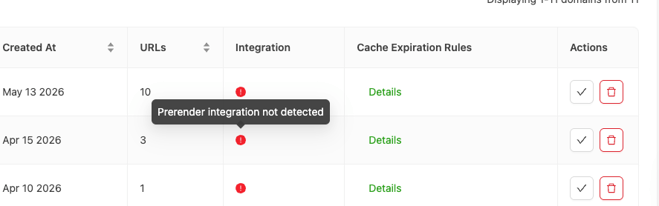
✅ Prerender.io is fully uninstalled when: integration code is gone from your stack, the cache is cleared, bot-emulated requests no longer return x-prerender-requestid, and the Domain Manager shows the integration as not detected for your domain.
Tips for a clean uninstall
- Watch your server logs. After uninstalling, monitor your logs for any remaining requests heading to
service.prerender.io. Any such requests mean an integration is still active somewhere. - Check every environment. If you removed Prerender.io from staging or development, make sure it's also out of production. Likewise across multiple sites or properties on the same account.
- Re-test affected pages. Use a header checker or browser dev tools to confirm that Prerender.io response headers (
x-prerender-requestidin particular) are absent on representative URLs. - Check your subscription. Uninstalling the integration does not cancel your Prerender.io plan. If you want to stop being billed, cancel your subscription separately from the dashboard's Billing menu.
Get support
If you have completed all four steps but Prerender.io still appears active, or cached responses are still showing up after the cache clear:
- Email support@prerender.io
- Or click the green Support button in your Prerender.io dashboard and choose Contact Support
To help us diagnose quickly, please include:
- A URL where Prerender.io is unexpectedly still active.
- A screenshot or copy-paste of the response headers from a bot-emulated request to that URL.
- Your integration type (plugin, middleware, CDN layer) and whether anything still sits in front of your origin (CDN, reverse proxy, edge worker).
Related articles
- How to purge your cache
- How to verify your Prerender.io integration
- Available integrations
- Domain Manager
💬 Still need help?
If Prerender.io still appears active after you've cleared the cache and removed the integration code, our support team can help dig into your account.
→ Contact us at support@prerender.io